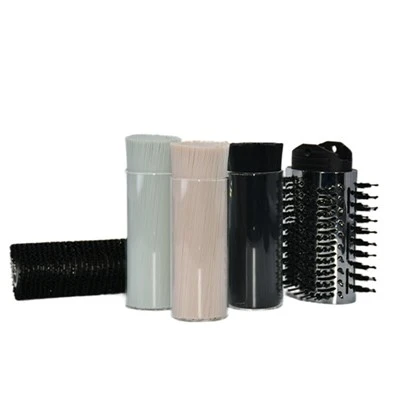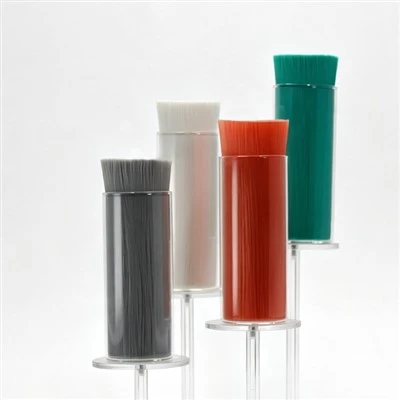


General Process for Synthetic Fiber Brush Filaments
Raw Material Selection: Materials such as Nylon 610, Nylon 612, PBT, and food-grade PP are selected based on product requirements; melt flow index and moisture content are tested prior to warehousing to ensure batch quality stability.
Mixing and Drying: Base materials are mixed with functional additives and antimicrobial masterbatches in specific proportions and thoroughly dried for 2–3 hours to prevent bubble formation during extrusion.
Melt Extrusion:Raw materials are melted in an extruder at temperatures between 180°C and 220°C and extruded through a die with precision micro-holes to form raw filaments.
Cooling and Shaping: Extruded filaments immediately enter a cooling water bath; temperature is precisely controlled to ensure filament roundness and diameter accuracy. High-end production lines utilize laser micrometers to monitor diameter deviations in real-time.
Stretching and Strengthening: Filaments are stretched using traction rollers operating at varying speeds to align polymer chains, significantly enhancing strength, resilience, and durability.
Heat Setting and Post-treatment: Stretched filaments are passed through a hot-air oven to relieve internal stress and treated with a lubricant to improve smoothness, preventing issues such as fuzzing or breakage during subsequent processing.
Tapering/Cutting:Filament tips are tapered or rounded as required to improve tactile feel; subsequently, filaments are cut to specified lengths, combed, inspected, and packaged.
Metal Brush Filament (Steel Wire) Process
Wire Drawing: Base materials-such as stainless steel, carbon steel, or copper wire-undergo multiple drawing stages to achieve the target diameter (ranging from 0.06 mm to 2.5 mm).
Forming: Crimped wire is shaped into a wave pattern with specific amplitude using a gear-based bending process; straight-cut wire undergoes straightening before being cut to the required length.
Inspection and Packaging:Parameters such as wire diameter, crimp specifications, and length are verified; compliant products are then packaged using composite materials and placed in storage.